
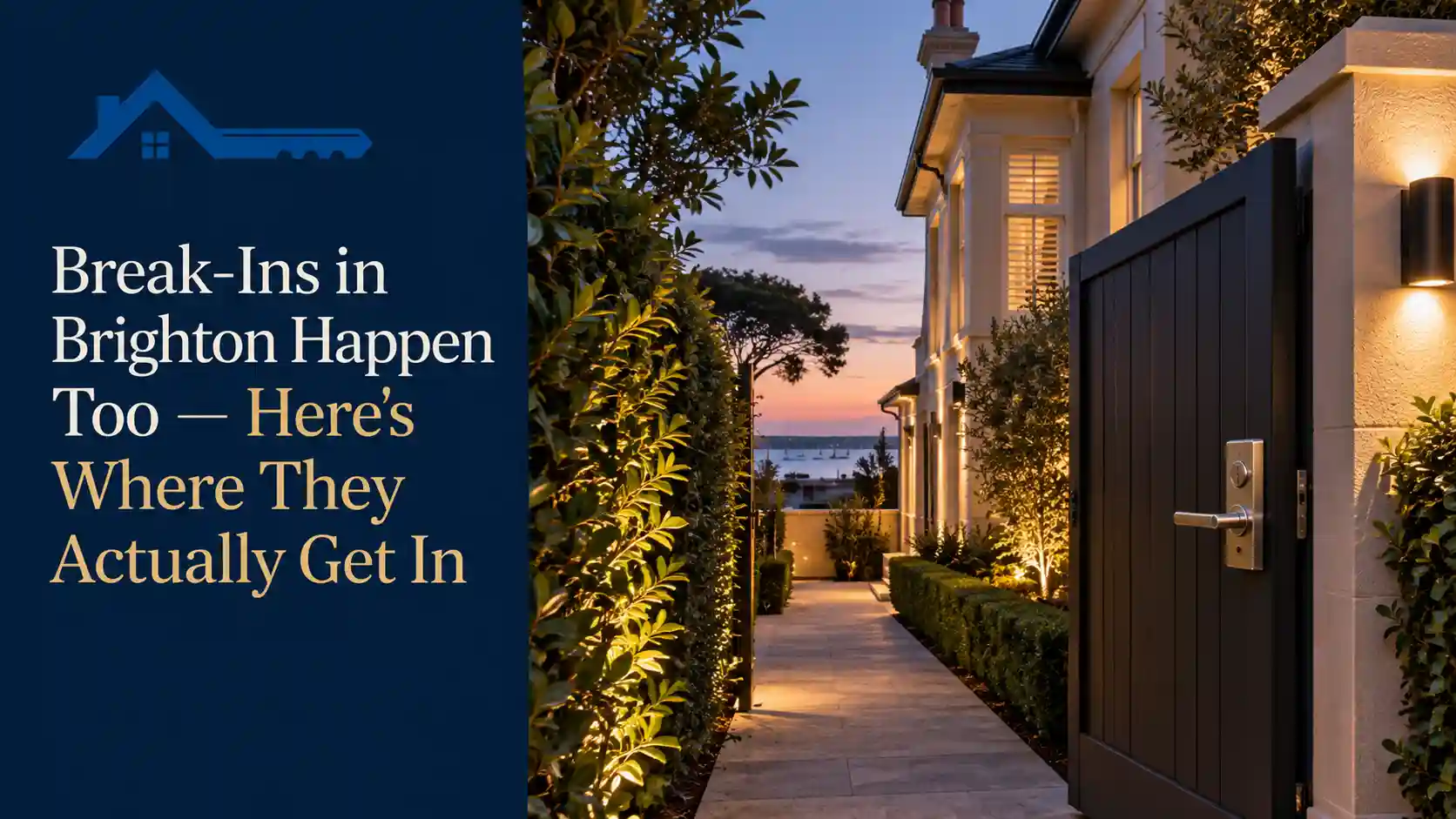
Brighton has a reputation as one of the safer, more settled bayside suburbs — and for the most part, it earns it. But “safer” isn’t the same as “immune,” and after enough callouts following an actual break-in, you start noticing the same patterns show up again and again, no matter how leafy the street or how solid the front door looks. If you own a home here, understanding those patterns — not just assuming a nice street keeps you safe — is what actually reduces your risk.
It’s Rarely the Front Door
Here’s something that surprises a lot of homeowners: the front door, the one they’ve usually already upgraded because it’s the most visible, is rarely where the actual entry happens. Break-ins in higher-value suburbs like Brighton tend to involve a bit of groundwork on the intruder’s part — noting routines, checking for signs the house is regularly empty, looking for the obvious mismatch between a property that clearly has money behind it and security that hasn’t kept up.
Timing matters too, and it’s not what most people picture. A lot of the break-ins I hear about across Bayside happen during the day, when the street’s quiet because everyone’s at work or the kids are at school — not the dramatic late-night scenario people imagine. That changes where your attention should actually go. Daytime vulnerability at a side gate or a rear window matters just as much as how strong your front door lock is at midnight.
And the pattern that comes up over and over: side gates, rear doors, garages and ground-floor windows are where entry actually happens, even on properties where the front door has a decent, visible deadlock. Nobody’s climbing over a house’s best-defended entrance when an easier, unseen option exists around the back.
Pro Tip: If your front door is your strongest lock but your side gate is a basic latch, you’ve secured the wrong entry point first.
Where the Actual Risk Sits
Fixing this starts with putting the money where entries genuinely happen, not where they’re most visible from the street. Bringing rear and side door locks up to the same standard as the front entry closes one of the most consistently exploited gaps I see across Brighton homes. Proper locking hardware on side gates — not the basic latch that comes standard — removes easy, private access to parts of a property that are hidden from the road, exactly where an intruder has the time and privacy to work without being noticed.
Window locks on ground-floor windows, and any upper-floor window reachable from a fence, garage roof or trellis, close another gap that gets overlooked constantly, particularly on older Brighton homes where original sash windows were never designed with security in mind. And garages — especially ones with internal access straight into the house — need a lock that’s genuinely secure, not an afterthought, because they’re often treated as a low-priority door despite offering a direct route inside.
Looking Secure Isn’t the Same as Being Secure
There’s a distinction I try to get across to every client: a heavy-looking lock on the front door doesn’t do much if the side gate right next to it lifts open in two seconds. Actually reducing risk means walking the whole property with fresh eyes, not just reinforcing the entry an intruder was least likely to attempt in the first place.
That said, visible deterrents genuinely do add value — alongside solid physical security, not instead of it. Good lighting, clear sightlines from the street to entry points, and hardware that visibly signals a serious approach to security all discourage the kind of casual testing that happens before someone commits to an actual attempt.
Pro Tip: Good lighting at side and rear entries removes the privacy an intruder relies on — pair it with proper locks, not instead of them.
A Practical Walk-Through Worth Doing Yourself
Before calling anyone in, it’s worth doing a basic version of this yourself. Walk your property the way an intruder would see it, checking every entry point rather than just the front door, and being honest with yourself about which parts of the house are hidden from the street or your neighbours’ view. Check that locks are actually functioning properly, not just present — a misaligned or poorly maintained lock can look secure while offering almost nothing in the way of real resistance. And think about whether your absence patterns — school runs, work hours, the same weekend routine every week — might be visible to someone who’s been watching the house for a while.
A locksmith who works Brighton regularly brings a trained eye to this kind of review that’s hard to replicate yourself, mostly because you see the same front door every day and stop noticing where it’s worn or where the gate’s started sagging.
It’s also worth checking strike plates specifically. A lot of homeowners focus entirely on the lock cylinder, but the strike plate — the plate on the door frame that the bolt seats into — is actually where forced entry attacks land. A standard strike plate fixed with short screws into soft timber offers very little resistance. Replacing it with a reinforced deep-set plate fixed with longer screws into the structural frame is one of the most cost-effective upgrades on any exterior door, and it’s something I check on every assessment because it gets missed so consistently. It also doesn’t affect how the door looks from the outside at all.
For heritage homes specifically, I’ll always check the door frame itself for any signs of movement or rot around the strike area, because an older timber frame that’s had water get into it can mean the screws aren’t biting into solid wood anymore, regardless of how good the lock above them is.
A Break-In That Didn’t Need to Happen
A job I was called to near Wilson Street is one I still think about when this topic comes up. The family had a solid deadlock on their front door — a decent one, actually, well-fitted and relatively recent. Their gate and rear door, though, were a different story. The side gate latched with a simple slide bolt, and the rear door had a single cylinder knob lock, the kind that can be forced in seconds or bypassed without much effort at all.
The break-in happened on a weekday morning while the family was at work and the kids were at school. Entry through the rear of the property, completely out of view from the street or any neighbour. The front door deadlock the homeowners had invested in wasn’t relevant to what happened at all.
When I came out for the post-break-in security assessment, the conversation was a hard one. Not because the family had done anything reckless, but because this pattern is so common and so preventable. A good front door lock instils confidence, and that confidence sometimes means the rest of the property stops getting attention. An intruder looking for an easy opportunity isn’t going to test the thing you’ve clearly spent money on — they’re going to test the things around it.
We upgraded the rear door to a proper deadlock, fitted a key-operated lock to the side gate, and added key-operated window locks to two ground-floor windows at the rear. None of it was expensive. The total job took an afternoon. And every bit of it addressed the actual entry points rather than the one the family had already secured. The front door was already fine. It just wasn’t where the problem was.
That’s the kind of clarity a proper property walk-through delivers, and why I’d always rather do the assessment before something happens than be called out to advise what should have been done first.
Why Local Knowledge Actually Changes the Advice
Risk isn’t identical street to street in Brighton, and knowing the area changes what I actually recommend. Some streets get more foot traffic and natural surveillance than others. Some back onto laneways or reserve land that offer easier, more concealed access. Some housing styles have known vulnerabilities tied to when they were built — an older sash window behaves very differently to a modern double-glazed one. That local knowledge is the difference between a generic national security checklist and advice that’s actually built around your specific street.
Reducing Risk Without Living Behind a Fortress
None of this means turning a beautiful Brighton home into something that feels locked down and unwelcoming. It means being deliberate about where you invest — bringing secondary entries up to the same standard as the front door, taking daytime vulnerability seriously instead of only thinking about it at night, and pairing genuine physical security with sensible deterrents that work alongside it. Get that combination right, and Brighton homeowners can meaningfully cut their risk while their home stays exactly as welcoming as it’s always been.