
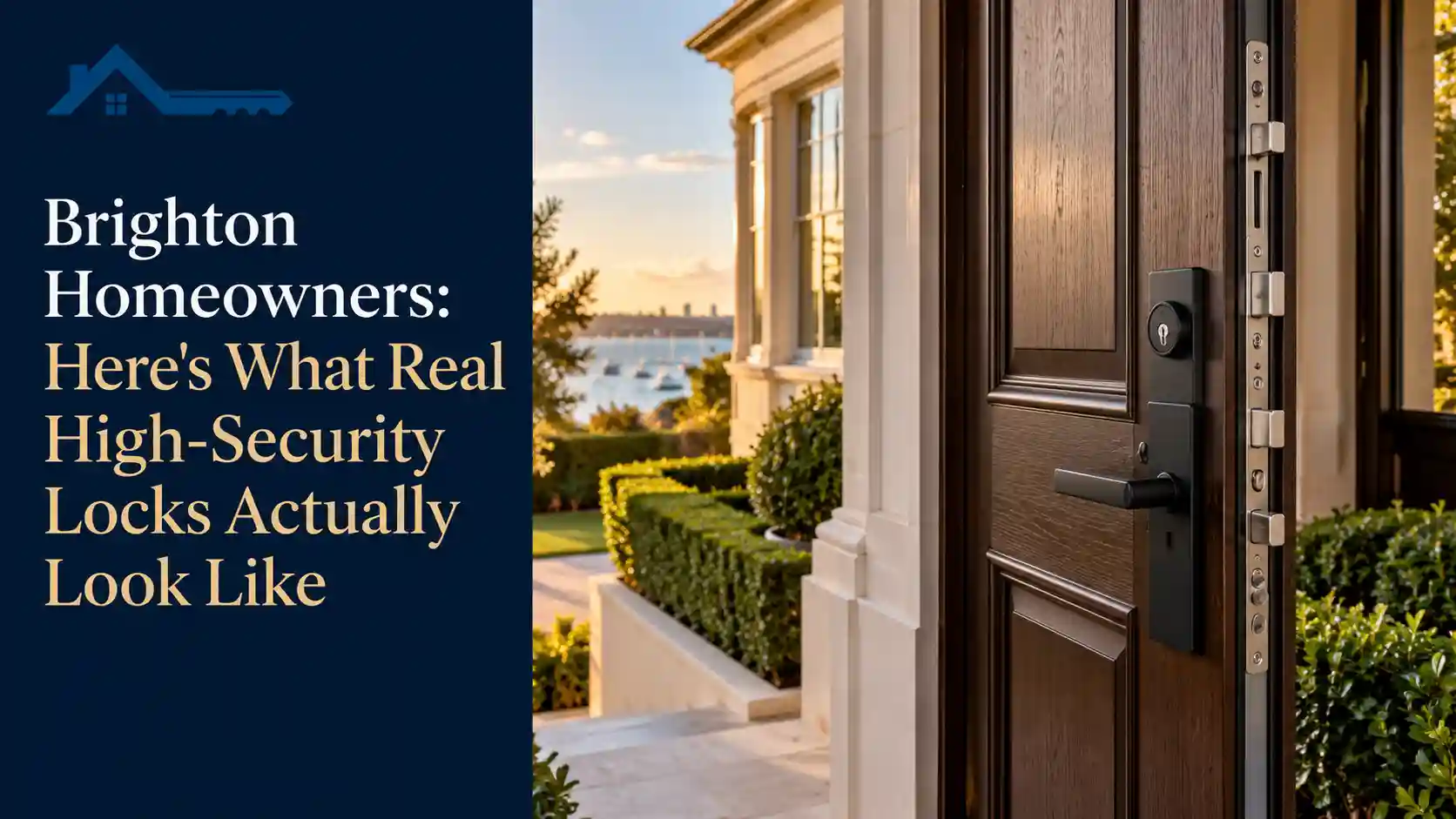
“High security” gets thrown around on a lot of packaging that doesn’t really earn the label. I see it constantly — a lock marketed as premium that, when you actually open it up, is barely a step above what came standard on a project home twenty years ago. For homeowners in Brighton, where property values sit well above the Melbourne average, that gap between marketing and reality matters more than most people realise.
I’ve been fitting locks across this suburb long enough to know what genuinely resists a determined attempt at entry versus what just looks reassuring on a showroom shelf. So let’s get into what actually makes a lock high-security, and where it’s worth spending the money on a Brighton property.
Why Standard Locks Aren’t Enough Here
Most locks fitted during original construction — even in a well-built home — are chosen for cost and building code compliance, not maximum resistance to a break-in attempt. They’ll tick the box, but a lot of them are vulnerable to picking or bumping techniques that are honestly more widely known than most homeowners would guess. For a premium Brighton property, that gap between “technically compliant” and “actually secure” matters more, simply because there’s more sitting behind that door.
Genuine high-security locks are built specifically to close that gap. We’re talking anti-pick pin configurations, anti-bump technology, hardened steel components that resist a drill rather than giving way to one, and restricted keyways that stop someone getting a copy of your key cut at the local hardware store without your say-so.
What Actually Separates a High-Security Lock From a Standard One
Because the term gets misused so often in marketing, it’s worth knowing what to actually look for. A restricted keyway is one of the clearest markers — it’s a patented key profile that only an authorised locksmith can cut, which means you control exactly who ends up with a copy of your key, not anyone who walks into a hardware store with your spare.
Pick and bump resistance comes down to more sophisticated internals — multiple pin stacks or sidebar mechanisms that make manipulation genuinely difficult without the correct key, rather than a five-minute job for anyone who’s watched a video online. Drill resistance comes from hardened steel inserts at key points in the cylinder, designed to blunt or jam a drill bit rather than let it through to the mechanism. And independent security ratings — actual third-party testing against forced and covert entry methods — give you something objective to compare, rather than trusting a manufacturer’s own claims on the box.
Pro Tip: A restricted keyway means you control who can get a copy of your key — not the hardware store down the road.
Where to Actually Spend the Money
Not every door on a Brighton property needs the same level of investment, and a sensible approach puts the money where it actually matters. The main entry is the obvious priority — it’s the most-used door and often the first thing an opportunistic intruder tries. But rear and side doors, garden gates and garages get overlooked constantly, and in my experience they’re just as often the actual point of entry, precisely because they’re out of view from the street.
For bigger Brighton properties, secondary structures — a pool house, a studio, a detached garage — often store genuinely valuable equipment or offer an unmonitored route into the main residence, and deserve the same level of consideration as the front door. Windows, particularly ground-floor ones and any upper-floor window that’s reachable from a fence or garage roof, are another spot that’s easy to underestimate when all the attention goes to door hardware.
It’s Rarely Just About the Lock
High-security locks work best as part of a wider setup rather than a standalone fix. Access control systems let owners of larger properties manage entry electronically — issuing and revoking access instantly for family, staff or contractors, without the risk of physical keys floating around indefinitely after someone’s stopped needing them. Master key systems are useful for bigger blocks or properties with multiple structures, letting you control exactly which keys open which doors — handy for separating access to a main residence, a guest studio and a garage.
Security-rated door and window hardware, including hinge bolts and multi-point locking, adds real resistance against forced entry attempts that target the frame rather than the lock cylinder itself — a detail a lot of homeowners don’t think about until it’s explained to them. And for anyone who wants the full picture, a proper security assessment walks the whole property looking for weak points, not just the ones that happen to be top of mind.
Pro Tip: Multi-point locking secures a door at several points along the frame, not just at the handle — a genuine upgrade against forced entry.
Security That Doesn’t Get in the Way of Living
For a premium property, upgrades need to fit around how the family actually lives, not fight against it. Nobody wants to juggle five keys at the front door on the way out, and nobody hosting regularly wants a complicated access process for guests. This is where good planning matters as much as good hardware — high security doesn’t have to mean high friction. A well-thought-out setup might pair a restricted-keyway deadlock on the main entry with an access control system on a side door the family actually uses every day, giving real protection without making daily life harder.
Discretion counts too. A lot of Brighton homeowners I work with want hardware that doesn’t visibly announce itself — sleek, well-finished locks and panels that sit with the property’s existing design rather than looking like a security add-on bolted on after the fact.
What a Security Review Looks Like on a Brighton Premium Property
A job near Head Street gives a useful picture of how a proper high-security review actually runs. The property was a large double-fronted home with a main residence, a converted garage that had been turned into a studio, and an in-ground pool with a separate equipment shed. The family had recently upgraded the front door with a deadlock that looked heavy-duty from the packaging, but when I assessed it, the cylinder inside was a standard grade that a bump key would defeat in under a minute. The rear of the property told an even more consistent story — the studio and shed both had basic single-cylinder padlocks that hadn’t been changed since before the current owners moved in, and the internal garage door connecting to the main house had no secondary locking at all.
The work ended up being spread across the whole property rather than focused on the front entry. The main door got a restricted-keyway deadlock from a certified high-security range, which also solved the key control problem — they’d had cleaners and contractors coming and going for years, and by now had no idea how many copies of the original key were floating around. The studio and shed got matching hardware on the same restricted key system so that one key controlled both, and a secondary mortice lock was fitted on the internal garage door. We also added hinge bolts to two of the main residence’s external doors, since the hinges on both were more exposed than ideal given the door profiles.
The total cost was more than just swapping one front lock, but the homeowners came out of it with a complete picture and genuine control over who had access to what — rather than a single strong door and a patchwork of vulnerabilities behind it. That’s the difference a proper assessment makes versus just responding to the most visible entry point.
Getting It Fitted Properly Matters as Much as the Lock Itself
Genuine high-security hardware needs more precision to install correctly than a standard lock swap. Cylinders need to be sized and fitted correctly so they don’t weaken the door itself, access control wiring needs to be run cleanly without damaging finishes, and master key systems need proper planning from day one — reconfiguring one badly set up later is a real headache. Working with someone who’s actually handled premium properties in Brighton before means these details get done right the first time, with the finish standard these homes deserve.
Match Your Security to What You’re Protecting
A premium Brighton property deserves security that matches its value — not just in the hardware itself, but in how carefully it’s all put together across the whole block. From a restricted-keyway deadlock on the front entry to access control for a growing household, the right combination gives Bayside homeowners genuine peace of mind without changing how they actually live in the house.